Replayable data infrastructure
for autonomous machines.
The data backbone for humanoid labs, AV foundation models, drone fleets, and robotics teams. Store large multimodal runs once, then replay, query, update, and retrain from the same data layer - hardened on one of the hardest production data problems.
-
System of record
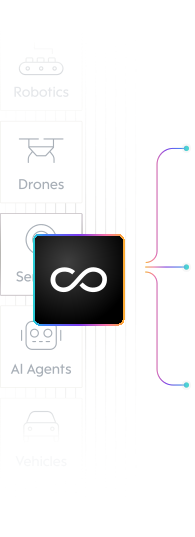
Every robot run, sensor event, and model action - stored in one replayable, correction-ready timeline.
-
Any run, any state, any time
Access real-time data, historical data, or a specific robot run through SQL, REST, or Arrow Flight.
-
From any point in history
Replay a failed robot run with corrected labels, updated calibration, or a new model. Same inputs, fresh outputs.
Physical AI is here.
The legacy data stack is the bottleneck.
A production robotics or physical AI stack runs on five or six fragmented systems, none designed to compose. Sensor data lives in one place, logs in another, annotations in another, replay jobs somewhere else. Debugging is manual, replay is unreliable, and corrections do not propagate cleanly.
- LLM Reasoning
- Redis State
- Vector DB Retrieval
- Postgres Logs
- Kafka Events
- Orchestrator Flows
The result: Teams spend more time stitching together data infrastructure than improving the models, robots, and fleet-learning loops built on top.
-
No single source of truth
Sensor data, logs, labels, calibration data, and replay state live across separate systems. No clean answer to what the robot observed, recorded, inferred, or changed afterwards.
-
Debugging is manual
When a run fails: was the sensor data wrong? Label stale? Calibration changed? Model behavior unexpected? The team reconstructs the run by hand.
-
Replay is unreliable
Cannot replay a failed run from a precise timestamp with corrected labels, updated calibration, or a new model.
-
No native correction layer
Sensor recalibrations, corrected annotations, and episode re-segmentation ripple downstream silently. Every team writes its own reconciliation logic.
-
Fleet data fragments fast
Every robot, run, site, and model version creates more history. Without a shared data backbone, fleet-learning loops turn into custom pipelines.
The data primitives
physical AI systems need.
Replay, correction, ordering, large-payload handling, and real-time + historical access - every team building production robotics and physical AI systems rebuilds these primitives by hand on top of fragmented data stacks. Continuum makes them part of the data layer.
- Memory
- Replay
- Correction
- Ordering
- Large Payloads
- Fusion
-
// 01 memory
Persistent timeline of every run, event, and correction
What the robot observed, recorded, inferred, acted on, and what changed afterwards - queryable by fleet, run, episode, timestamp, sensor, or entity. Built to survive model upgrades, retraining cycles, and team handoffs.
-
// 02 replay
Replay any run from any historical point
Replay a failed robot run with corrected labels. Replay an episode after sensor recalibration. Replay a fleet's last 30 days against a new model or policy. From a position, timestamp, run ID, or session ID.
-
// 03 correction
Correction handling at the storage layer
Continuum can roll back to a prior position, invalidate affected data, and expose corrected history from the storage layer. Sensor recalibrations, ground-truth re-labelling, episode re-segmentation, and corrected annotations become data-layer workflows, not custom reconciliation code.
-
// 04 ordering
Strict global ordering at scale
Multi-sensor robotics streams stay aligned. Robot runs, episodes, and fleet events stay ordered across concurrent writers through session-based concurrency. Parallelism without losing the chain.
-
// 05 large payloads
10 MB+ payloads, native
Multi-camera demos, AV sensor frames, LiDAR/radar payloads, MCAP/rosbag recordings, embedding batches, and full robot episodes - the natural unit of work, not an edge case.
-
// 06 fusion
Live + historical from the same data layer
The same data feeds real-time inference, fleet monitoring, batch retraining, replay, and analytics - without duplication, ETL, or separate replay infrastructure.
Data in.
Queryable history out.
Whether sources are MCAP recorders, rosbag2 workflows, sensor pipelines, robot fleet logs, Kafka streams, or SDK calls, Continuum converts server-side to Apache Arrow and stores as columnar Parquet on S3. The same data feeds inference, retraining, analytics, and replay - through the interfaces each team already uses.
- Kafka
- AMQP / RabbitMQ
- Amazon SQS
- REST / SDK
- Arrow Flight
MCAP recorders · rosbag2 workflows · Sensor pipelines · Robot fleet logs · Kafka streams · SDK calls

- Inference loops
- Retraining
- Iceberg / SQL
- Replay engine
- Foxglove · MCAP
ClickHouse · DuckDB · Spark · Snowflake · BigQuery · Pandas · dbt
Data published via any protocol is immediately readable via all others. No ETL. No connectors. No secondary copies.
Built for physical AI teams with the toughest data.
Four segments, one data backbone. The pain shape is the same: large payloads, ordered history, replay, correction, and real-time plus historical access.
-
Robotics & physical AI
Humanoid foundation labs, AV foundation models, mobile manipulation, drones, and robotics fleets. Episode replay, sensor recalibration, ground-truth re-labelling, fleet-wide retraining, and long-term sensor history.
Physical Intelligence · Skild · Figure · 1X · Apptronik · Wayve · Aurora · Skydio · Shield AI · Recursion
Where it breaks today
Episode segmentation breaks under append-only streams. Multi-MB sensor frames and MCAP recordings force claim-check workarounds. Fleet-learning loops require replay from any point in history, but today’s stack can only replay from limited retention windowsWhat Continuum offers
Multi-MB payloads native. Episode-level replay, correction handling at the storage layer, and queryable fleet history from one data layer. Online inference, batch retraining, and replay use the same data - no duplicate pipelines, no custom reconciliation. MCAP-compatible. Foxglove-friendly.
-
AI agents & agent platforms
Software agents, research agents, customer experience agents, and vertical workflow agents. Persistent state, workflow replay, correction propagation, and multi-agent coordination.
Cognition · Cursor · Sierra · Decagon · Adept · MultiOn · Hebbia · Harvey · Lindy · 11x
Where it breaks today
Production agents fail without clean replay. State is scattered across vector DBs, Postgres, Redis, and Kafka. No single source of truth for what the agent knew, did, or changed afterwards. Multi-agent coordination is DIY.
What Continuum offers
Persistent state and deterministic replay as data-layer primitives. Rerun a failed workflow from step 11 with a new model. Expose corrected history from the storage layer. Shared state for agent fleets via globally ordered streams.
-
Defense AI & sensor fusion
Autonomous systems, Intelligence, Surveillance, and Reconnaissance (ISR) platforms, and teams working with imagery, signals, radar, and communications data. Built for replayable history, audit-grade traceability, and multi-modal payload handling.
Saronic · Saildrone · Hidden Level · Anduril ecosystem · Helsing partners
Where it breaks today
Sensor data, mission logs, annotations, and replay tools live in separate systems. When a sensor is recalibrated or an incident needs review, teams have to reconstruct the timeline by hand. The streaming layer moves the data, but does not provide the queryable history needed for replay, audit, and after-action review.
What Continuum offers
Replay from any historical position. Correction handling at the storage layer. Audit-grade traceability built in. Multi-modal sensor payload handling without claim-check workarounds. Same architecture proven at petabyte scale on one of the hardest production data problems.
-
Frontier AI labs & data infra
Multimodal training data curation, post-training data exhaust, embedding batches, simulation data, and replay-heavy model evaluation.
Anthropic · Together AI · DatologyAI · Eventual · Modal · Recursion
Where it breaks today
Training data corrections require full reindexing. Curated datasets get retroactively re-labelled. Multimodal payloads strain Kafka-style infrastructure. Multi-team coordination over the same data drifts into duplicate pipelines.
What Continuum offers
Correction-aware multimodal event store with replay primitives. Curate, correct, and retrain without rewriting the pipeline. Arrow Flight surfaces for high-throughput training reads. Iceberg-native storage for SQL-side curation.
Different starting point.
Different primitives.
A growing set of companies share the view that physical AI and autonomous systems need durable data infrastructure. We see this as validation that the architectural direction is correct. The differences matter.
-
Category 01
Streaming incumbents
Kafka · Confluent · WarpStream · AutoMQ · RedpandaOptimized for small messages and append-only history. Large payloads, queryable storage, replay, and correction handling require additional systems layered on top.
-
Category 02
Vector DBs & AI memory frameworks
Letta · mem0 · Zep · Pinecone · WeaviateBuilt upward from LLM orchestration. Useful for retrieval and agent memory, but not designed as retained event-data infrastructure for large payloads, correction handling, and historical replay.
-
Category 03
Robotics data infra
Foxglove · Rerun · Voxel51 · LanceDBVisualization, local debugging, dataset curation, and multimodal lakehouse tooling. These layers solve different problems from Continuum and compose well with it - Continuum sits underneath as the retained, replayable, correction-aware event-data backbone.
Also see: Blockchain and Fintech solutions
Blockchain proof callout
Continuum is the same data engine, hardened on blockchain - strict ordering, large decoded payloads, correction handling for reorgs, replayable history, and production-scale retention. The proving ground for physical AI data infrastructure.
Building physical AI or robotics systems at production scale?
If you’re stitching together Kafka, S3, Spark, MCAP files, and custom replay jobs to make robotics data usable at scale - or hitting Kafka’s payload ceiling on multimodal sensor data - we’d like to hear what you’re building.
Tell us about your robotics, physical AI, or autonomous systems project and we’ll show you what Continuum can do.